Things happen
Geoengineering for boy scouts

Finance writer and inbox folk hero Matt Levine has a subsection in his newsletter called Things happen. Recently, I’ve felt like the world is set to 1.25x, and I can’t help but want to add, “sooner than expected.” To be fair, it’s a sentiment so universal it’s a trope: Hemingway goes broke gradually then suddenly, Blockbuster dismisses Netflix and regrets it, climate change surprises us yet again, the IEA keeps missing solar predictions. Seeking solace and calm, and grasping around for a way to process it all, I found myself feeling increasingly attached to the Boy Scouts’ iconic and timely motto: “Be Prepared.”
With the tape speeding up and preparation front and center, I want to return to the topic of geoengineering with the following premises:
We are going to deploy solar radiation management (SRM) in a state of disorder and emergency.
Therefore, the only precondition for its deployment will be its technical functioning, not geopolitical consensus.
But, to do SRM well, we will need coordination and consensus, which requires the government to step into critical roles.
Read on for why that’s a problem and what I think we can do to be good scouts given the circumstances.
Part 1: Break glass case of emergency
The types of events that seem likely to trigger the scaled deployment of SRM look to be specific and extreme. Crop failure, mass casualty events, drought -- disasters. In conversation about SRM, advocates often imagine tidy progress towards deployment, i.e.,1) develop global consensus, 2) test and improve technology, 3) deploy at scale with broad support. Explorations of SRM in sci-fi don’t support this view, and instead look, well, more haphazard.
Common daily preparations for smaller emergencies agrees with the sci fi version of events. For example: we don’t proactively remove the emergency hammer from its protective housing on the bus, swing it around to get a good feel, and then get fellow commuters aligned on which one of us will be the one to break windows when needed. We wait for the emergency, then whomever is closest breaks glass. I think the same will hold for SRM.
If the trigger for deploying SRM at scale is a specific event, then the response should be expected to be fast and under duress - whoever is closest breaks the glass. Anything that is not already in place — consensus timelines for rollout, global coordination on goals, discussion of tradeoffs, etc. — will likely be discarded in the name of an expedient (probably political) response to a disaster. So, if we want to have a chance to do SRM in a way that is conscientious and has a broadly positive impact on the world later, we must start now.
Part 2: Geo (mostly not) engineering
If I could put one thing into the mind of everyone excited about solar radiation management, it would be this: it’s only superficially an engineering problem. Most every investor I know, and essentially everyone I talk to in climate, thinks roughly the same about SRM: technically challenging but very doable. That is, of course, the appeal: it’s cheap and relatively easy in comparison to more systemic change. For example, we could, simply, put the sulfur back in bunker fuel. We could fill big balloons with sulfur dioxide and let them go. We could do other, more sophisticated things involving planes and special particles. We’ve got options, and some certainty. Everyone feels much less comfortable with the social side of the problem.
At its very core, geoengineering is mostly a social problem, meaning broad success relies on consent, and coordination, and incentive structures, and proof, and shared goals, and resource sharing, and conceptions of the commons, and freerider challenges, and unaligned actor management, and tradeoffs, and compensation mechanisms. Clearly, the solution must be mostly social. Which is why I’m more pro-deployment than most people I know. Not because I think we need to test the tech (though we do). But because small, early deployments are the only way to force the messy social work—forging agreements, setting standards, developing compensation structures, and so on from the “someday” column to “today” column on the global to-do board. Without a real deployment on the table, there’s no forcing function. So, when most people say, “this is really socially complicated, we shouldn’t get started.” I find myself saying, “Yes exactly, which is why we should get started.”
So, let’s be Boy Scouts and get prepared. If for-profit companies will do the work (as I argue here), what will be required of governments?
Part 3: Jobs so bad, only a government can do them
Four roles, all critical, all hard:
1. Target painter
One imagined bad outcome is that for-profit geoengineering companies are incentivized to make as much money as possible, and therefore are misaligned with the public. This is a real risk! If they get big and make lots of money, they will use some of that money to lobby governments to their interests. This is regular and should be expected (gestures toward the oil and ethanol lobbies, and the military industry complex).
So we need the government to have a very clear target that all of the prospective participants can work towards (assuming some private and some public/military participation in the effort.) This target needs to be set by as broad a community as possible, and progress towards it needs to be transparent. Roughly, it’s better to think about the companies that will cool the planet, like electric or water utilities: likely to operate in a highly regulated way with local monopolies, capped returns, etc.
I expect the job of defining “what we want” to be very very very hard. There are a lot of potential vectors for complexity and misalignment here. For example: do we want the temperature of the earth to be what it was in 2000? 1980? 1925? 1800? How much are we willing to pay? How much are we willing to tolerate negative externalities? How quickly do we want to change things? If we’re going to make progress, we need to be aligned on our goals.
2. Scoreboard
To that end, governments need to do two things: set the standards for what a unit of SRM is broadly enough so that companies can innovate on the methods (novel particulates, delivery methods, etc). Second, governments must either monitor directly, or pay someone to verify the delivery of the public goods. I want to raise a bright red flag that says something like “assume there is a problem here that won’t go away.”
When governments buy tanks or satellites, verification is easy—you can see the tank. SRM is not like this, and verification can’t be done easily. Unfortunately, some of the people who know the most about verification and can confidently say something like, “we have reflected enough sunlight to reduce the temperature of the planet by .1C” are likely to work at these SRM startups themselves. This is natural, but not optimal because it makes them likely to repeat the mistakes of the carbon removal world: delivering an innovative new product or service and certifying their own work. Market participants should either deliver a product or service to a standard, or verify the meeting of the standard. Not both.
In the carbon dioxide removal (CDR) market this - the “did X actually happen” problem - is well trodden terrain, but unfortunately isn’t particularly well solved. The incentives around private sector verifiers are not helpful. If you run a for-profit SRM company, and need certification to get paid, you’ll shop for the friendliest certifier - one that either increases the price (via credibility) or increases the volume (via accounting and process leniency). This shopping happens in CDR, and it appears that while the top end of the market will pursue increases in price via high quality verification, much of the market will pursue higher volumes and lower standards. And remember before you get real mad, the BUYERS often prioritize low prices over rigorous verification. In doing so, a classic tragedy of the commons scenario plays out. It has already in tree carbon.
Thus, given that the end-state of the SRM market is the procurement of a public good, it would be good to avoid the heartache implicit in the creation of private and competing standards.
3. Referee
An obvious bad outcome would be that a geoengineering company develops a way to cool the planet that is 1/10th the cost of competing strategies, but has some bad externalities. Say, it increases the incidence of asthma by five percent globally. The company is incentivized to downplay this risk so that it can win contracts and make money. The government’s job is to make sure the conversation about trade-offs is public and transparent. This is a hard job.
Another rake waiting to be stepped on takes the form of innovation: a new geoengineering company generates a novel, and patented, method for generating the same cooling effect for 50% less than the existing providers. Because the purchaser is the government, not corporations, the purchasing incentives are bad: the existing providers are going to use every tool to prevent losing their market to new and better entrants. Our deal managers of the SRM purchasing fund are going to need the moral clarity of an evangelist, lifetime appointments, personal financial security, and a thousand other things if we expect them to act responsibly on our behalf. A supreme court of SRM buyers, if you will.
There are other challenging questions. Should a government provide seed grants for new SRM tech that competes with existing providers? Should it compete on industrial policy with other nation states? What about permitting timelines for new techniques and evaluation of localized effects? The list goes on.
4. Escrow
There are going to be tradeoffs. Expensive ones, and likely dire ones. You’ll hear people mention rainfall changing snowpack in the Himalayas, endangering water access to hundreds of millions of Indians, but that doesn’t sound fun. Let’s pick something cute: for example, in Okanagan British Columbia, a no-longer-particularly-frigid region of the great white north, they now grow grapes and make delicious wine. Naturally, they planted grapes as soon as it was warm enough - about 30 years ago - because anytime you get to make wine in a place that looks like this in the summer, and still play pond hockey in the winter, well you gotta.
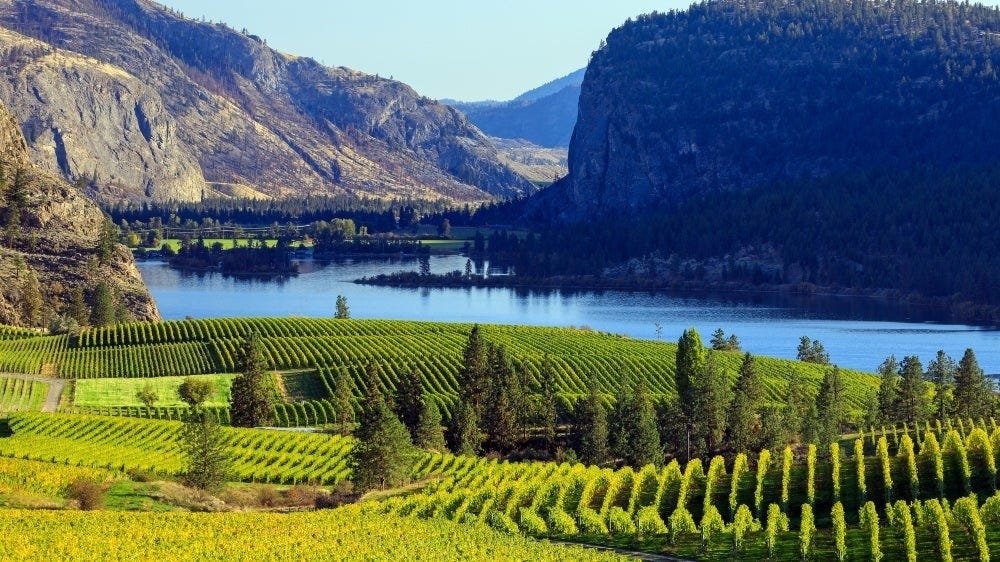
Anyway, word on the street is there are about 200 wineries there, producing about $2.8 billion in Canadian dollars in GDP contribution. Let’s say we wanted to use SRM to make it as cold as it was in 1950, and in doing so save the Amazon, prevent a billion people losing their homes to the ocean, avoid mass heat death events in India, etc. Seems reasonable! Except for our sweet-skating viniculturists, who might want some compensation for seeing their businesses put on ice. Who pays? If we can figure out who pays, how do they pay? And, where do they pay? What happens with the money? This, I think you can imagine, will not be child’s play, and especially so when our example isn’t twee and affluent and instead grim, and close to famine and an international border.
“governments”
Yes, well, about that. Ideally… ideally… each government wouldn’t do each of the steps above alone. Ideally, they would discuss and compromise and finally agree with each other, and share goals, standards, and negotiate compensation. If you haven’t looked out the window in a minute, I’d suggest you sit down before you do, because our current trajectory suggests the UN is not going to be showing up to wrangle these cats. Which brings me back to my earlier point. If this is a social engineering problem, which I believe it is, and it is hard, which I believe it is, then we should get started working on the solution now. If we can’t do the social engineering required to deploy 1 ton, and then 100 tons of sulfur dioxide, then we will have our answer - global coordination is impractical, and SRM would be revealed to be technically feasible but impossible to implement, like communism or prohibition.
If that is the case, I would like to know that soon! As soon as possible, even. It would be better to know that now, as opposed to after we have spent a decade fine tuning SRM technology which would trigger a geopolitical conflict if deployed.
So, let us start. Small, and soon. And let us see what we can do, what progress we can make. If things go right, maybe we can even get back to the bit we’re all excited about: flying planes and saving the world.